Image 1 (Pages 144 & 145)
Page 145 — Auschwitz: Capital of Crime
— On the morning of June 2, a Stubendienst came to tell us that several doctors would be designated for transfer to the Gypsy camp. The news of a transfer is never joyful in a concentration camp. The Block boss came shortly after to tell us it was decided and handed the list to the Schreiber. The latter called out the numbers and mine was on the list.
— We said goodbye to a few comrades and descended into the courtyard where we found several dozen inmates from other blocks. Among them was Doctor N.S., whom I had known for about a month. A secretary came to call the roll and we lined up in ranks of five. Our group consisted of Pflegers-doctors and Pflegers-non-doctors. A few SS came…
Footnote:
Unpublished manuscript by Iancu Vexler written specially for this chapter on Auschwitz. Doctor Iancu Vexler, who shared the life of the Gypsy camp, provides here the most precious, most complete, one could write the most “intimate” document ever made about deported Gypsies. A privileged observer, friend to many Gypsies, he was able to understand this people, and no one better than him could make us understand them. Iancu Vexler presented himself thus, in March 1973, when interrogated by a German tribunal charged with investigating the “Mengele affair”: — Before World War II, I was a doctor and practiced in Saint-Cyr-sur-Marin (Seine-et-Marne). I am of Israelite origin. Before World War II, I did not yet have French nationality. I do not know if I had Romanian nationality or was stateless. — At the beginning of September 1939, I was requisitioned as a doctor by the French civil authorities and had to practice in Saint-Germain-sur-Morin. — In January 1940, I enlisted in the French Army, but it was only in June that I was called up to the military orderlies section; I finally joined this formation in Gourdon in Lot. I stayed there for a short time and was demobilized on July 13, 1940. I then returned to my practice in Saint-Cyr-sur-Morin in August. — At that time, the German invasion was accomplished.
Image 2 (Pages 146 & 147)
Page 146
…to form the escort under the command of a non-commissioned officer whom we knew. He was an easygoing man, speaking German and Polish, joking willingly. I never saw him hit anyone, even when angry. He had a Polish-sounding name that I regret having forgotten.
— The route we followed to go to Birkenau was the same one I had traveled in reverse in December 1942, when I was transferred from Birkenau to Auschwitz. I could once again see emerging on the horizon the town of Oswiecim (Auschwitz), a triangular silhouette whose steeple formed the point. But what a change! After crossing construction sites, we walked along groups of barracks surrounded by their electrified barbed wire enclosures, but the number of buildings had increased. These were camps C, D, E, etc. I had known the beginnings of these camps in November 1942, but at that time they were deserted. Now the bustling activity in them exceeded that of Auschwitz.
— As we advanced, a murmur composed of voices mixed with musical instrument sounds became more and more audible. Suddenly the escort leader told us:
— “There, you see it now.”
— Indeed, we saw a multicolored crowd where men, women, and children could be clearly distinguished, and we heard singing choirs dominated by female voices. We stood spellbound. Everything was strange, starting with our march. The whole time it had lasted, we had not once been encouraged by blows or exhorted by…
Biographical details continuation: — Because of my Jewish origin, I began to be harassed by the French State after the summer of 1940. I was notified of the ban on practicing medicine, but thanks to Dr. Maurice Tixier of the Departmental Council, I was able to continue practicing until the eve of my deportation. — On October 20, 1942, I was arrested at my home by French gendarmes from Rebais and Coulommiers. — My wife was arrested at the same time. The gendarmes took us by car to the Melun Commandancy. From there we passed through a Hitlerite military tribunal, then we were taken to Drancy camp. From Drancy we were taken by rail, in freight cars, to Birkenau; the journey took about forty-eight hours. That is how I entered Birkenau camp. I was to remain in this camp until late January 1945. — Upon my arrival I was assigned to Birkenau camp, to Block no. 9, section B. 1; it was a brick Block. The next day I was tattooed on my left arm with the number 74154. — I remained at Birkenau until December 23, 1942. I was then transferred to the main camp of Auschwitz. I stayed there until June 2, 1943. — In June 1943, I was transferred to the Gypsy camp at Birkenau. I was assigned there as a doctor in Hospital-Block 32 to treat Gypsies.
Page 147
…usual words. “Tempo! los! srybko! Drecksau” and other familiar invectives.
— The SS escort told us:
— “Halt! Mützenab!” (Halt! Caps off!)
and we stood motionless in front of the guardhouse at the gate. The non-commissioned officer announced the number of inmates transferred to the Zigeunerlager; we were counted and entered.
— An incredible sight. Was it a dream or a farce? Inhabitants approached without fear, children ran about freely, people were talking. To our question:
— “What does this procession of women singing in chorus mean?”
— We received the astounding answer that this procession was returning from delousing (Entlausung). Thus this painful operation, dreaded in all camps, took on the appearance of a fair in the Gypsy camp.
— We were led to a block where a Polish doctor, the chief physician of the Krankenbau (the set of infirmary blocks), spoke to us properly and assigned us to the various blocks. I was assigned to Block 32, the last on the right before the sauna. There I happily reconnected with Polish doctors Ko and Sn.
— It is known that the blocks of Birkenau (with the exception of the women’s camp) called Stallbaracke are all identical: an entrance door at each end, a double chimney running from one end to the other. This double chimney is horizontal and serves as a bench on which people sat comfortably, especially in winter when it was hot. On either side of this chimney, three-tiered bunks with straw mattresses and blankets like in Auschwitz. Most of the sick were naked.
— In 1943, the epidemic of exanthematic typhus was making havoc among the Gypsy population and our Block was crowded with sick people. Several doctors as well as many orderlies were affected, some fatally. Two Jewish doctors died in June and I lost an excellent German-Aryan friend (Hitlerite terminology). Thus a Pritsch (bunk) theoretically designed for 12 sick people (4 × 3) held 18, 20, and even 24. The morgue was full every day. One might ask why the infirmaries of the Gypsy camp were so crowded while those of Auschwitz main camp were relatively comfortable. The answer is simple: the SS kept watch, and as soon as a block was threatened with overcrowding, trucks came and transported the sick Jews to the gas chamber. In contrast, Gypsies were supposed to die a “natural” death (illnesses without appropriate care: scabies…
Image 3 (Pages 148 & 149)
Page 148
…infected, deficiency diseases). They were and knew they were safe from death by gas.
— The Gypsy patients were calm, patient, trusting. They spoke their fluent mother tongue among themselves, that is, German, Czech, Slovak, etc., which they sprinkled with Gypsy words. Since they were squeezed together in their beds, the less sick took up more room by pushing away the weakest. Furthermore, and this happened often, those who could eat were in no hurry to report deaths among them, because they took their food rations. They pushed death away toward those who could no longer defend themselves. Here is a conversation overheard on the lower tier of one of these dark communal beds:
— “Mendl (maybe Gerth), call someone to remove the moulo (dead body) lying on top of me. Don’t you see he stinks already?”
— “Shut up, you miserable Gypsy (clender Zigeuner), it’s you who stink.”
— “What, you call me a miserable Gypsy, but you’re a Gypsy yourself.”
— “Shut your mouth (halt die Schnauze), you know I don’t even have 20% Gypsy blood, whereas you…”
— After food distribution, the death of the “rate” was declared and the “eaters” shared his portion. The “non-eater” received nothing because he was no longer even in a state to eat his own.
— I heard many times arguments in German where antagonists threw in each other’s face their “rate” of Gypsy blood. Thus Hitlerism had managed to instill in many of these brave people a feeling of indignity and shame regarding their ancestors, whereas the fine Gypsy song “Faria” says: “Lustig ist das Zigeunerleben…” [Merry is the Gypsy life…] and Goethe exalts the sacrifice of Gypsies who give their lives to defend Götz von Berlichingen, the “iron-handed knight,” who died for the freedom of the German people!
— Toward the end of summer 1943, exanthematic typhus was declining after having felled several thousand Gypsies. Our block changed occupants: from men’s service it became women’s service. The women we had under treatment, being “privileged internees,” were not afflicted with common “privileged” diseases—that is, not resulting from trauma like other deportees (diarrhea, deficiency edema, infected scabies, septicemia, tuberculosis). They were…
Page 149
…almost all naked in their beds and walked completely naked to the latrines at the end of the block. Female modesty seemed to have been lost. That was only in appearance. In reality, when physical degradation is very profound, the suffering of wounded modesty merges into global suffering and ceases to be perceived in isolation. A few still had a rag for a shirt and even shoes.
— The doctors rigorously kept the patient records and had a few medicines: a little sulfonamides, Mitigal (against scabies) in small quantities, analgesics, Kaolin, Borsalbe, Ichthyolsalbe. To keep the records, they were assisted by female secretaries: Polish, German, or Gypsy. Personally, I first had a cultured Polish lady who spoke French very well. This lady, widow of a Polish personality shot by the Germans, was at the Gypsy camp with her daughter. She felt the need to confide while knowing she was talking to a Jew. She told me her grief at seeing her daughter “live her life.” This girl was about twenty years old and was of dazzling beauty, a specifically Polish beauty. She seemed even more beautiful to me than Maria Walewska. We all knew that the chief doctor of the Krankenbau, much older than her, was her lover, and she was proud of it.
— When this Polish lady was transferred to the Frauenlager (women’s camp), I received a German Gypsy secretary who spoke and wrote German perfectly. In September or October, she was moved, and as secretary I had a very young German Gypsy girl speaking a picturesque and archaic German, reminiscent of “Yiddish” pronunciation. This secretary did not know how to write but was an adorable student. While I wrote, she watched with moving attention the tip of the pen and her lips spelled out the letters softly. A young Polish Pfleger, employed in the administration of the Krankenbau, fell genuinely in love with her. He dictated short letters in Polish to me, which I translated into German so he could read them to Frieda. The young girl spelled along with me and learned to read.
— Dr. Mengele came almost every day to the Gypsy camp, and each time all the children ran toward him with shouts of joy: “Uncle Mengele, uncle Mengele.” He questioned us with great simplicity, standing at attention before him was not rigid. After the inspection, he went to the sauna where he examined interesting types of Gypsies.
Image 4 (Pages 150 & 151)
Page 150
— One day—I don’t remember if it was in September or October 1943—the arrival of the “Lagerarzt” was announced. The usual preparations for his reception were finished, and the “Lagerarzt” made his entrance, but… it wasn’t Mengele, it was Thilo. As much as Mengele had an open face with regular features, Thilo had a closed and stern face.
— Doctor Thilo made a brief inspection of the block and addressed Mrs. L. Ad, our colleague, asking her to show him her patients. He inspected several. The poor women could barely stand. He told them to return to their beds, then standing in the middle of the Block, arms outstretched and index finger pointed toward poor colleague L.A. in the posture of the Archangel with the flaming sword driving Adam and Eve from Paradise, he declaimed in a terrifying voice:
— “I saw these women upon their arrival at the camp. They were blooming (il a dit blühend). Look in what state you have put them. If you continue, I will drive you out of the Krankenbau and you will go croak (sic) (il a dit verrecken) in a Kommando.”
— The poor colleague, crushed under the insult, trembled with shame, humiliation, and fear. She didn’t even have the ability to sit down. I need not say that madam (I think she was called Miss) L.A., known for her work on tuberculosis treatment, took not a moment’s respite and dedicated all her time to her poor patients. Once Thilo had left, we approached her, and Doctor Sn said to her in our name to console her:
— “Any camp doctor can receive the same reprimand. In fact, we are all guilty: of lack of medicine, inedible food for sick people, lack of hygiene, promiscuity.”
— I may have seen Doctor Thilo once more in the Gypsy camp, as he probably had to devote himself to selections.
— Early autumn was beautiful and warm, and rumors circulated that convoys coming from France and elsewhere were becoming rare. This revived hope and encouraged medical personnel to intensify efforts to cure the sick.
— There was in our Block a young Pfleger registered as “Reichsdeutscher” named Erich, whose face bore an astonishing resemblance to the famous statue known as “Cheik-el-Beled.” This young orderly privately told everyone that he was a Gypsy (which seemed certain) and that he was in the camp for seducing dozens of young wives of offi…
Page 151
…cers fighting at the front (which was perhaps less certain). He derived a naive pride from having thus doubly “fooled” the Reich. I advised him several times to stop talking about such things. Whenever I saw him conversing with a Pole or a Gypsy, and especially with a German, I approached to try to give another turn to the conversation, because I knew the subject, seeing him laugh with a triumphant look. My efforts certainly failed, as I later saw from “confidences” that could be called public, which unfortunately led him astray.
— German Gypsies who listened to his confidences rejoiced. It was a naive way to take revenge on the “scoundrels,” as they called those who had deported them.
— In general, Czech Gypsies resisted imprisonment better than German Gypsies, and this is understandable: Czech Gypsies knew why they were in the camp. They felt they were sharing the suffering of the entire Czech people. When they sang the Czech anthem, always followed by the Slovak anthem, their patriotic fervor was that of the Czechoslovak people. In contrast, German Gypsies did not know why they were there. Many had served in the French campaign as German soldiers, and I saw dozens of badges from the N.S.D.A.P. and B.D.M. It was at the camp that I heard for the first time the “Frankreichlied,” march of France: “Über die Schelde, über die Maas, marschieren Wir nach Frankreich hinein.” (Beyond the Scheldt, beyond the Meuse, we march into France.) Others had been in Russia and sang for me several times the Russlandlied: Wir standen für Deutschland auf Posten, und hielten die heilige Wacht (…) Führer, befiehl, wir folgen dir, etc. (Führer, command, we follow you.)
— Were they then rejected by the German people? Inconceivable, unthinkable. So a clique of “scoundrels” (Schurken) had deported them to strip them and perhaps let them die—”What clique?” This uncertainty eroded their moral and physical resistance.
— Czechoslovak Gypsies, sharing the fate of the Czechoslovak people, also shared their hope and certainty of German defeat. German Gypsies were victims, like the German people, of propaganda and like the German people, did not know that Germany would be defeated.
— Afternoons were often quiet and work…
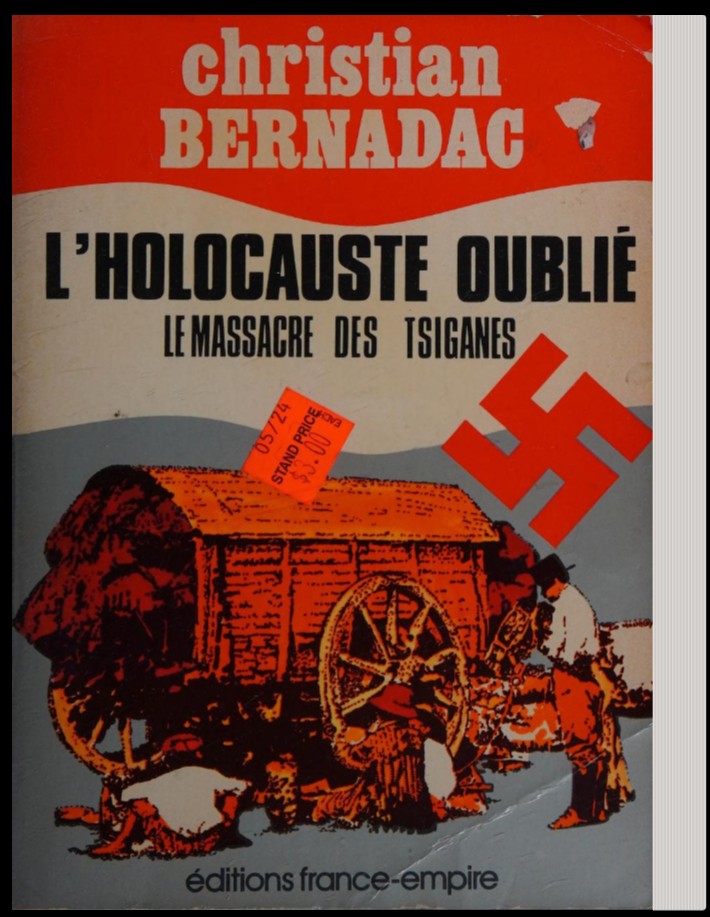
https://archive.org/details/bwb_W9-CJX-204/mode/2up
L’Holocauste Oublie Le Massacre Des Tsiganes
“The Holocaust Forgets the Massacre of the Gypsies/Roma”
by Christian Bernadac
Publication date 1979
Publisher Editions France-Empire
This is a wild extended version of the article published by Dr. Jancou Vexler, the REAL eyeball extractor and doctor in the gypsy camp under Dr. Josef Mengele.
This version has some incredible new details that all ring true.
Jancou Vexler was no vindictive lying fraud like Miklos Nyiszli, who all the academics cite and some-fuckin’-how suppressed the testimony of Mr. Vexler, who tells a completely contrary story to that of the fraudster Nyiszli.
This version presents even more problems for the Mengele hoaxing industrial complex…
One additional story and something I always wondered about and now have confirmation of- Vexler missed the – from tuberculosis – death of one of the Mechau family with heterochromia – two different colored eyes. He is given a heads up that he missed the extraction, and the body was already cremated the day before. He improvises to save himself and extracts eyes from one brown eyed person and another blue eyed person.
This is something I always wondered about and completely helps us understand the process. It almost seems believable that if these eyes were so important, Mengele would have stabbed them in the heart and sent them right to extraction. But that never happened, only in Nyiszli’s sick – and enabled by all of the corrupt field of “holocawst” academia, ruthlessly dominated by Jewish cultists themselves who have imprisoned and force sterlized myself and have Europe and now Australia and other countries legally mandated to imprison holocaust skeptics / debunkers and deny you to even VIEW THIS VERY WEBSITE which demolishes their various perjury-based scams.
But THIS isn’t perjury, NO LIES DETECTED.
It’s too bad there aren’t more honest Jews like Dr. Vexler. Jews would have no problems with those they find themselves living among. Unfortunately, that is not the case and we need to pry the cabal that steers the Jewish cult out of power over our laws, our lives, and our freedoms.
There are more interesting anecdotes in this extended version.
A whole lotta singing and also sex…
More honest testimony that takes the stand I have put forward- that Mengele at times did what he could despite orders from above to improve conditions for those under his care. That’s what Vexler says. And hey – he says it’s UNDENIABLE!
For me, and for YOU – if you’re a truthseeker, and not an inbred cultist Cabal member, all this Nyiszli-debunking eyewitness testimony is like a gift from Santa Claus – who makes an appearance in this extended version 😉
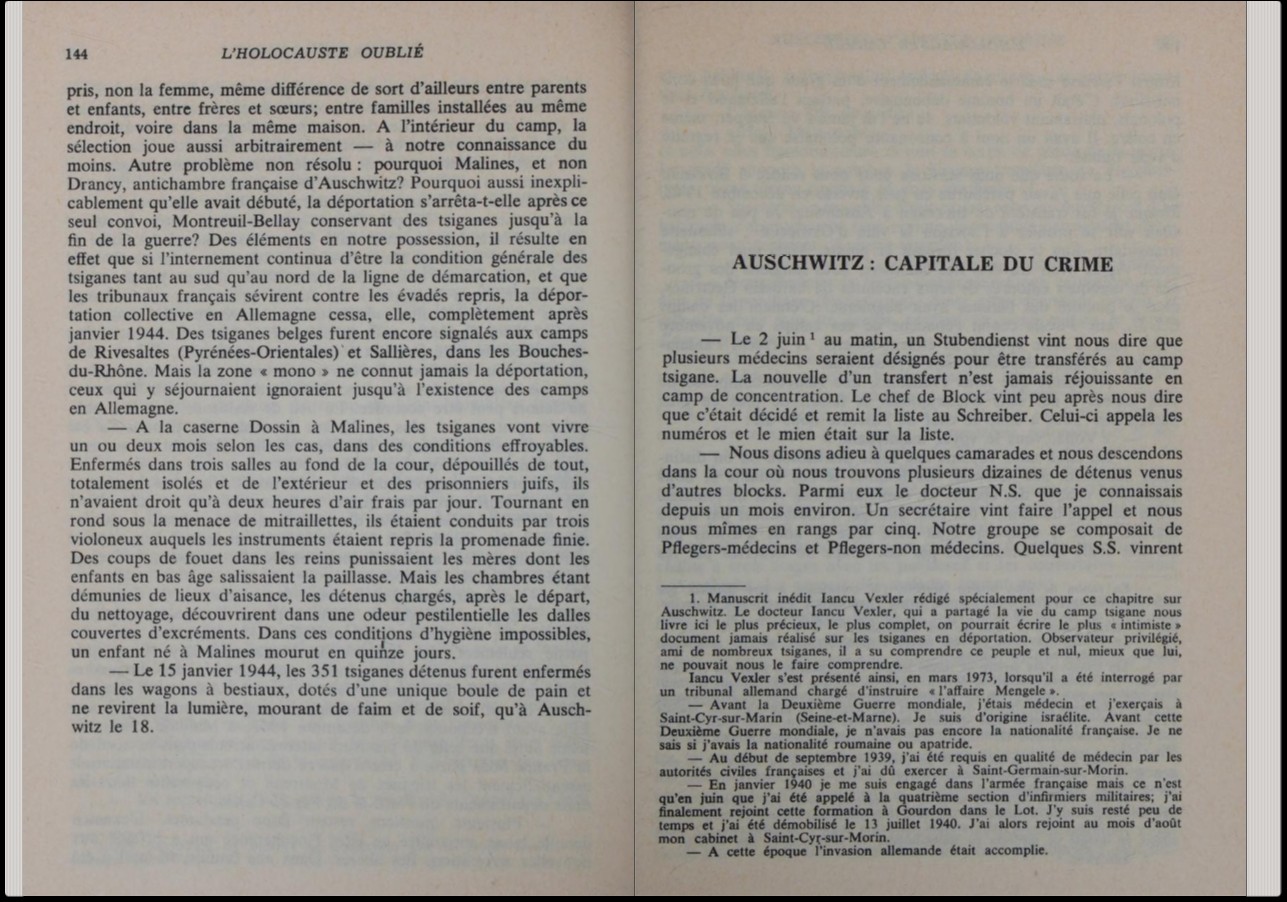
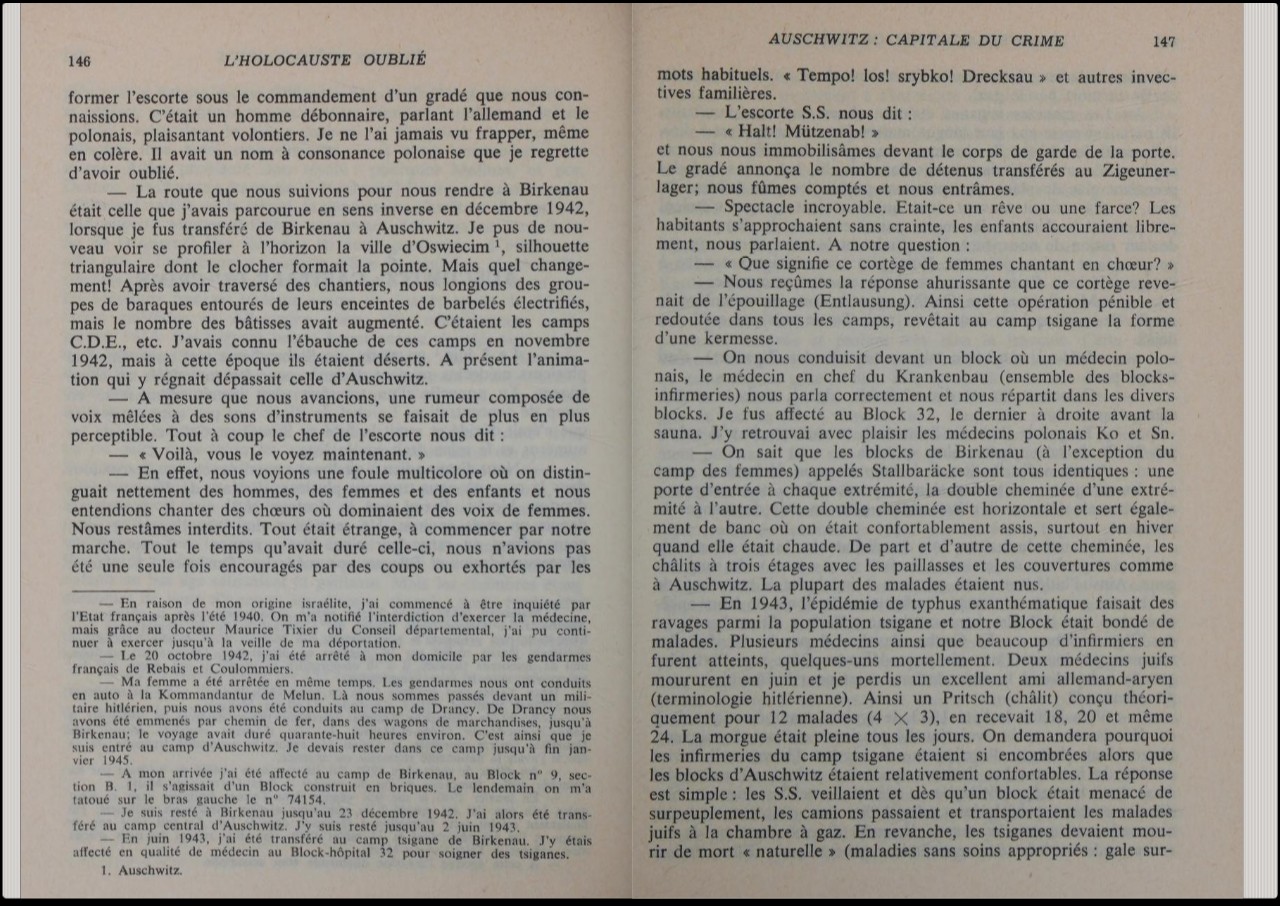
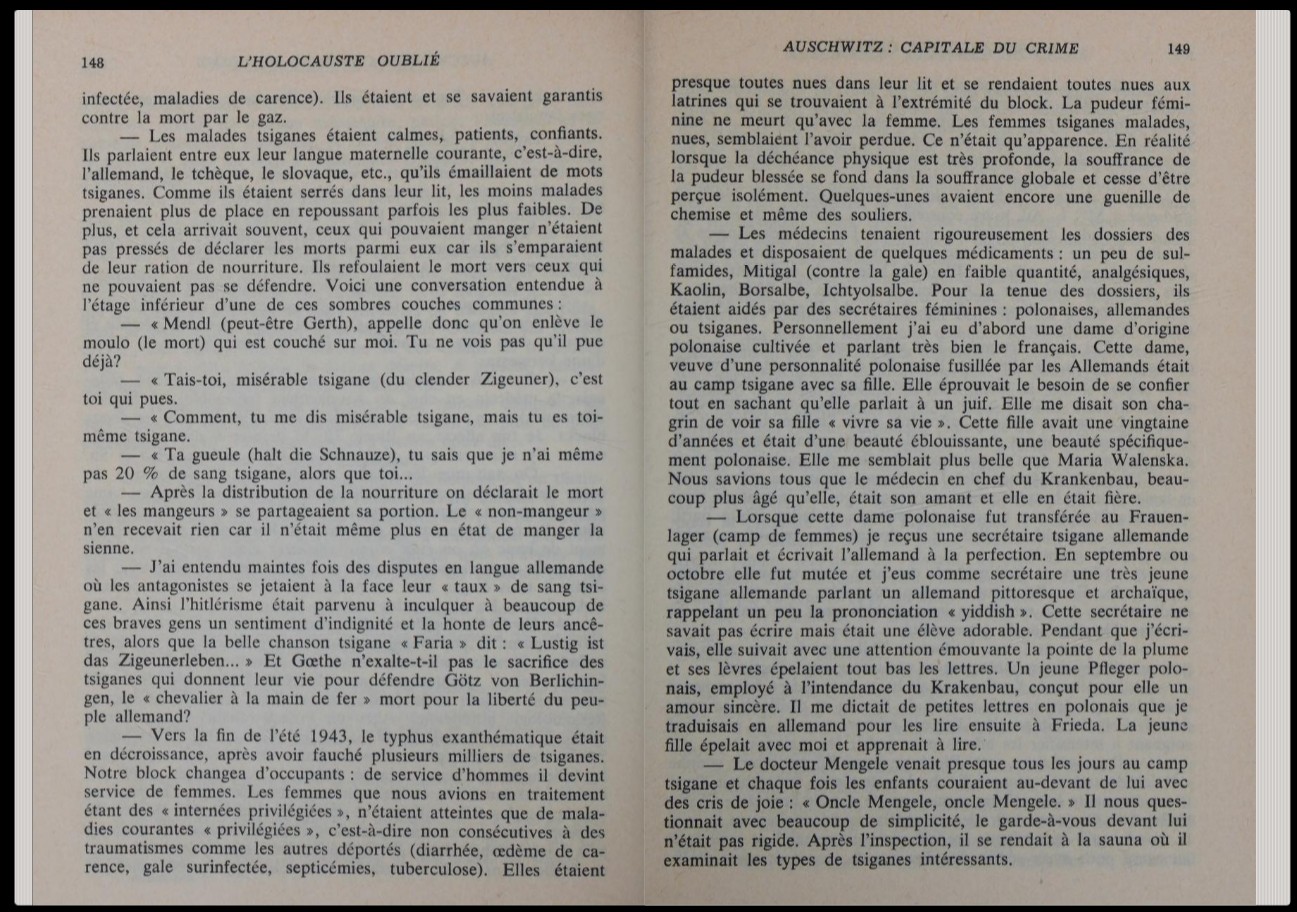
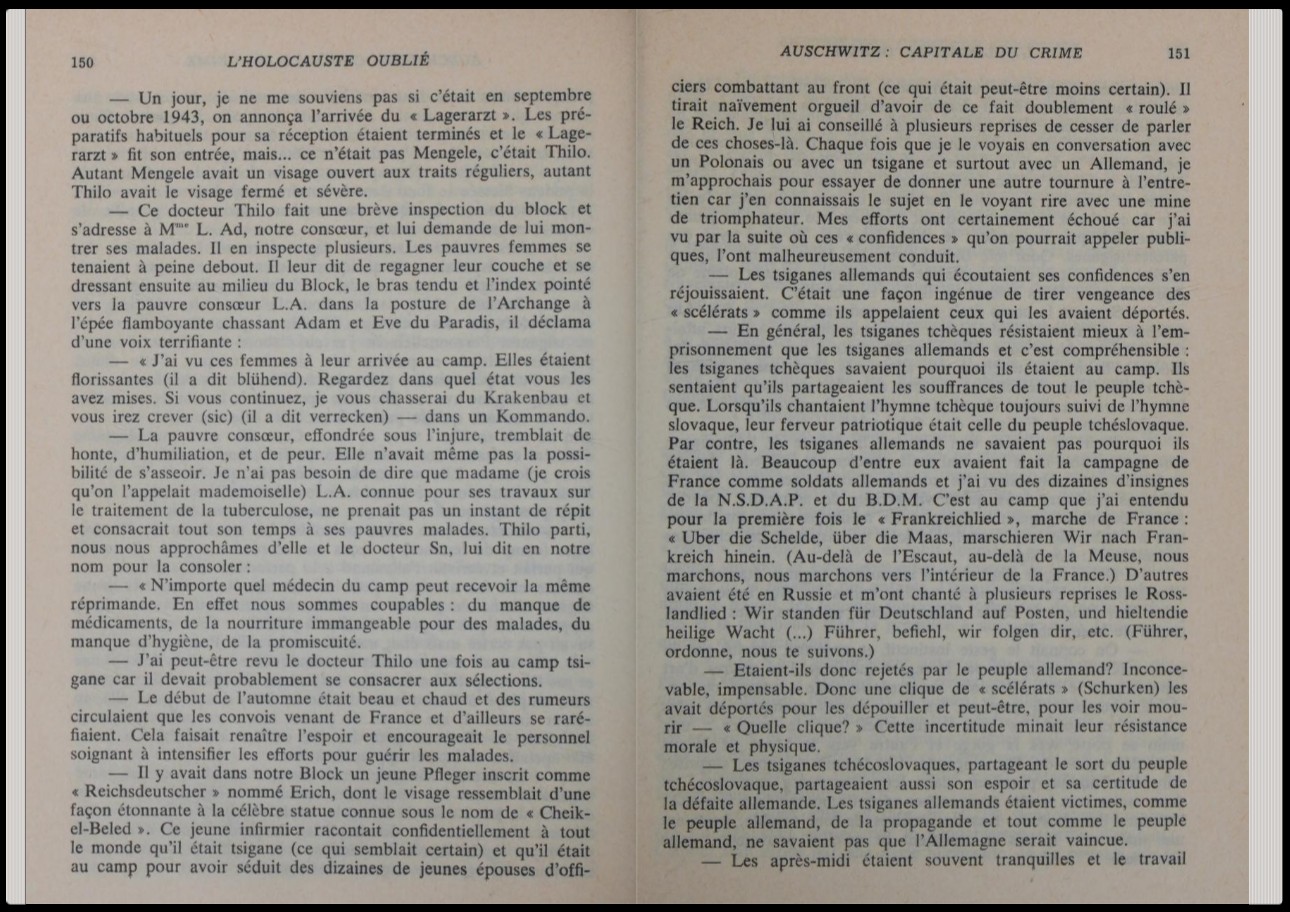
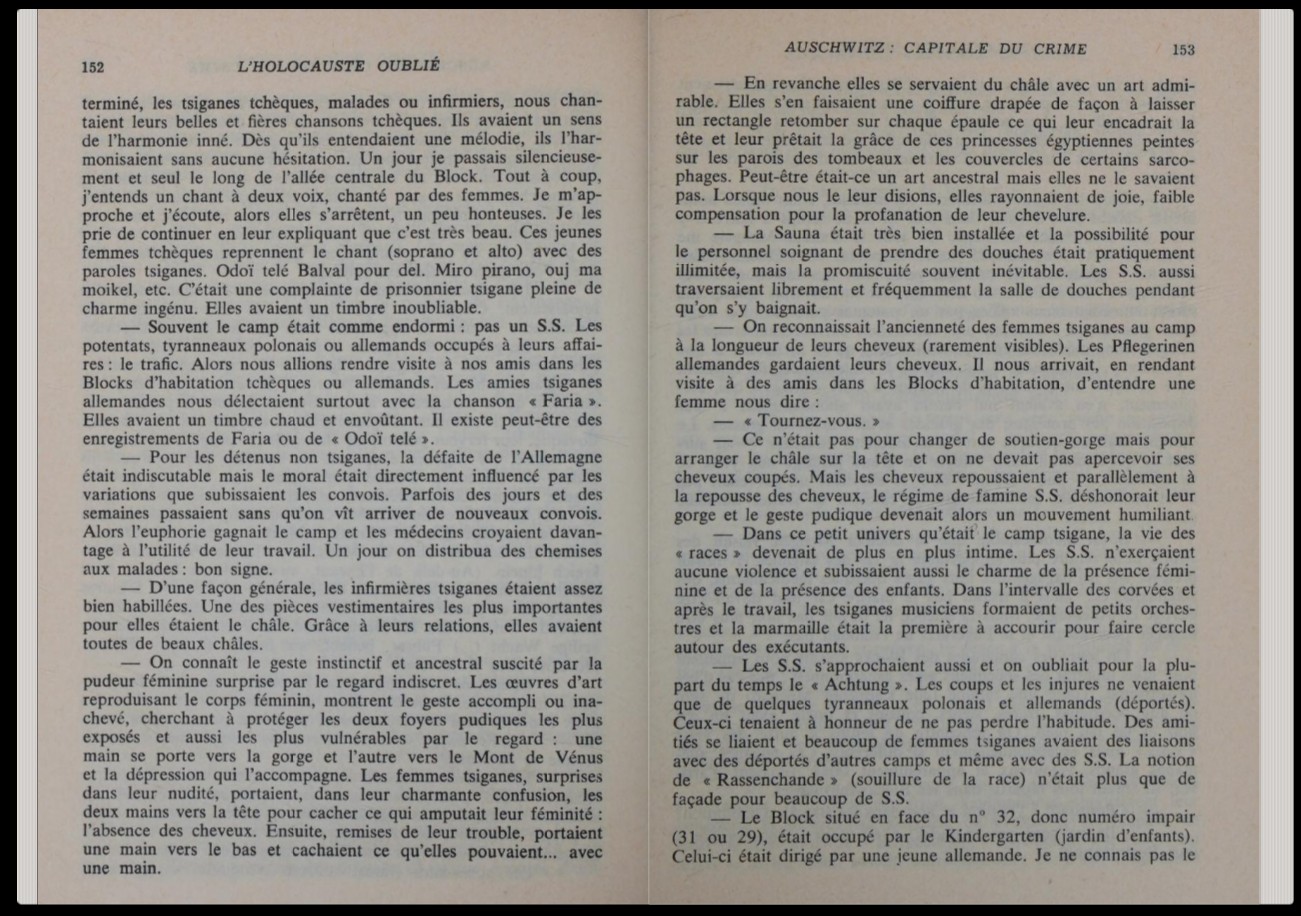
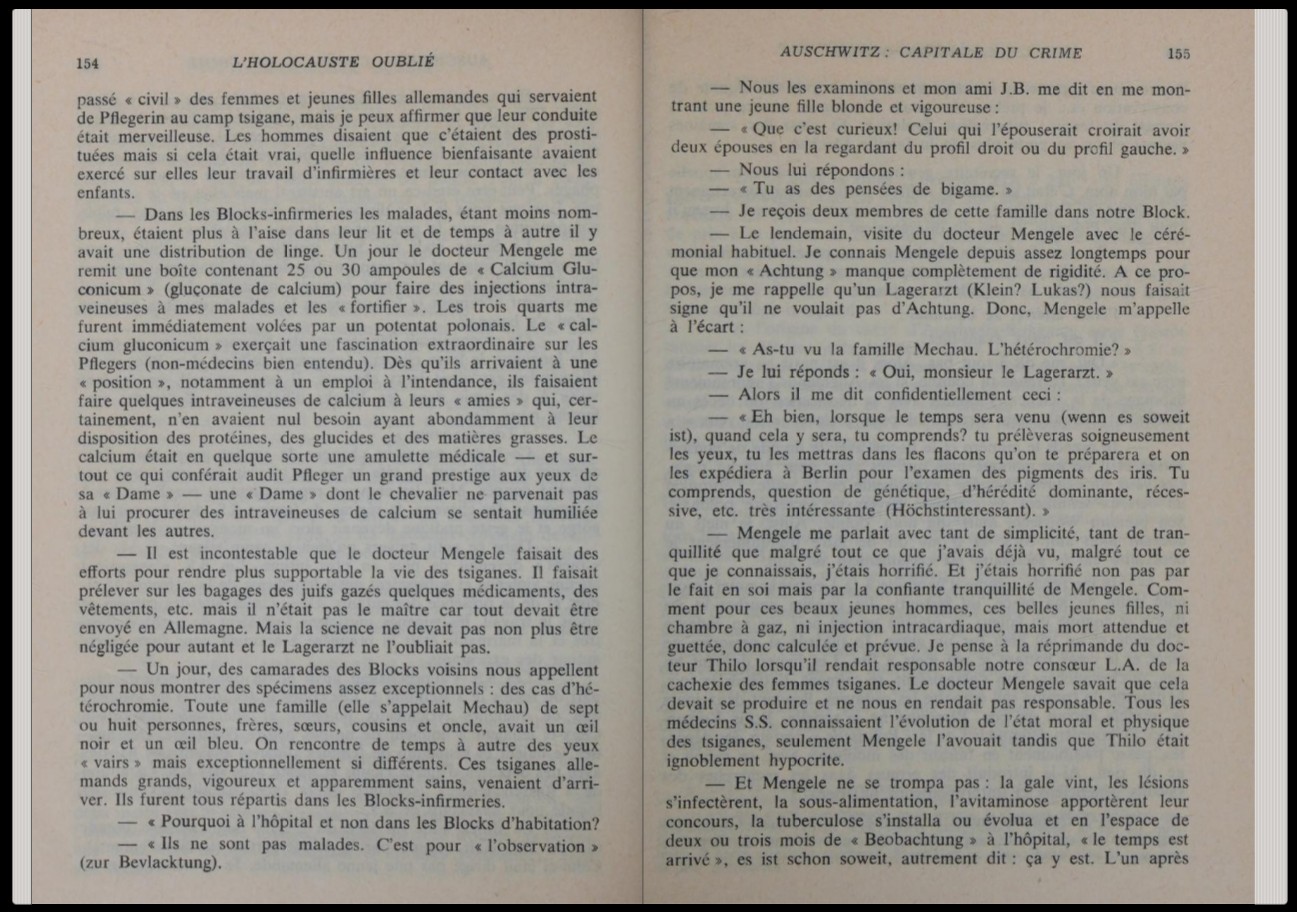
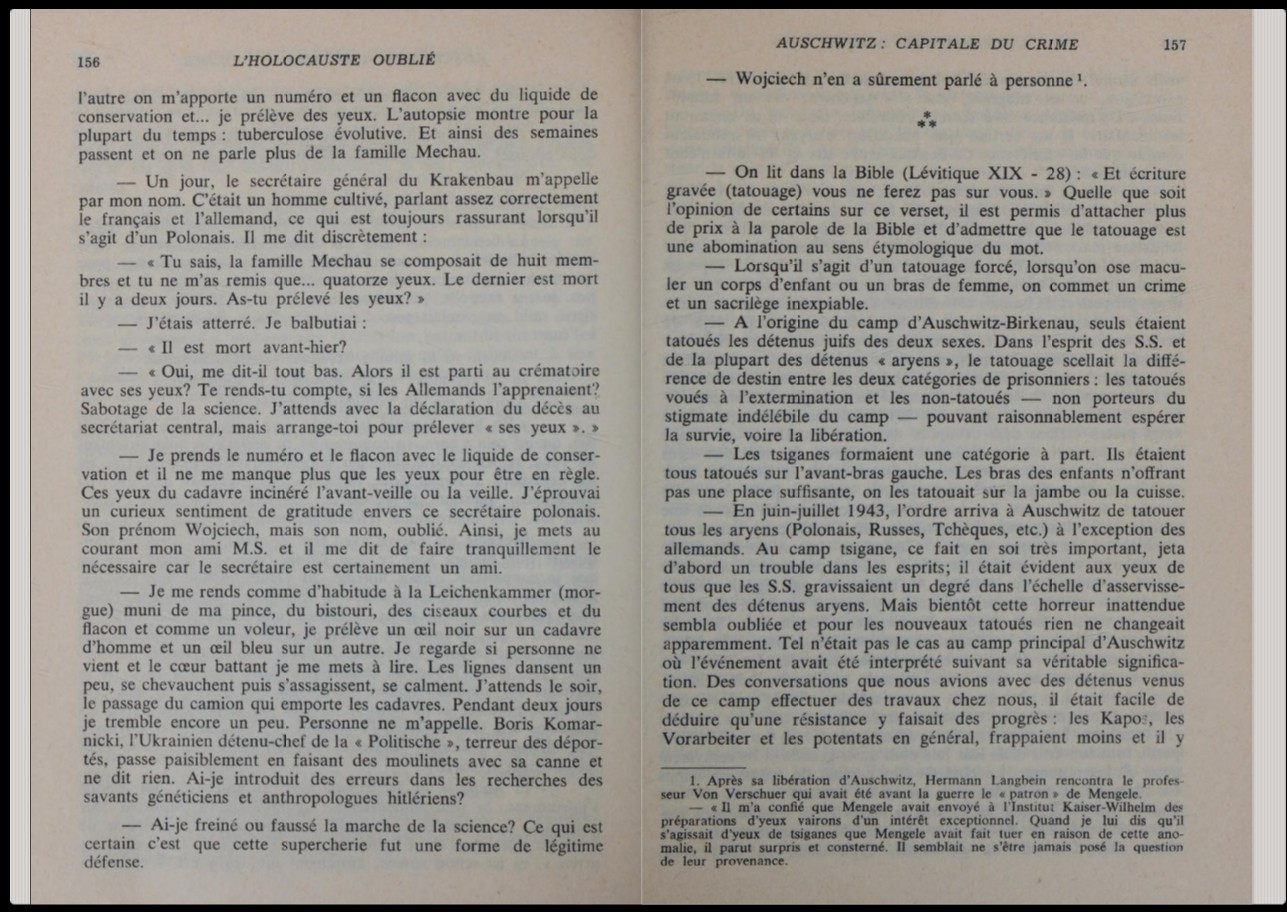
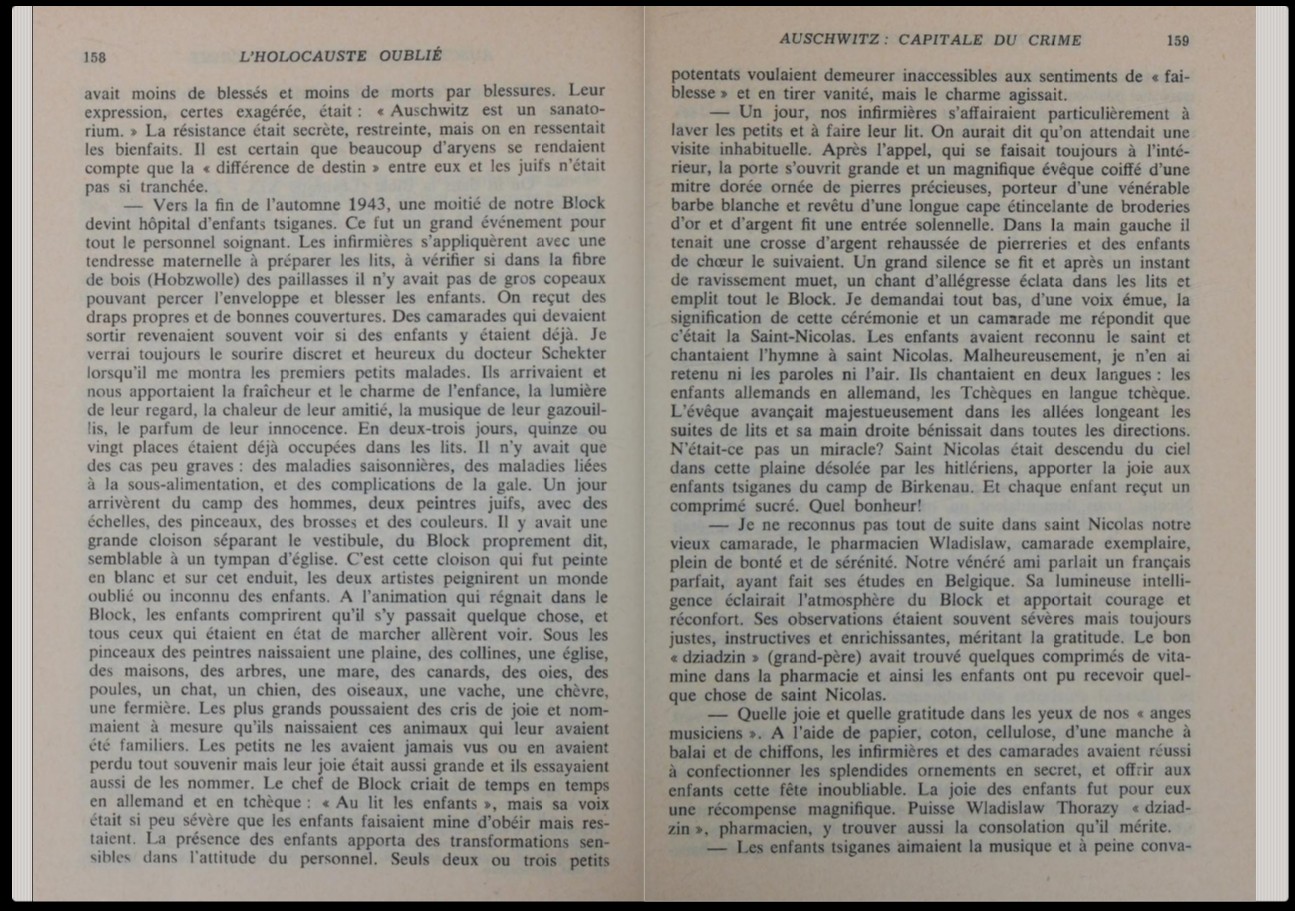
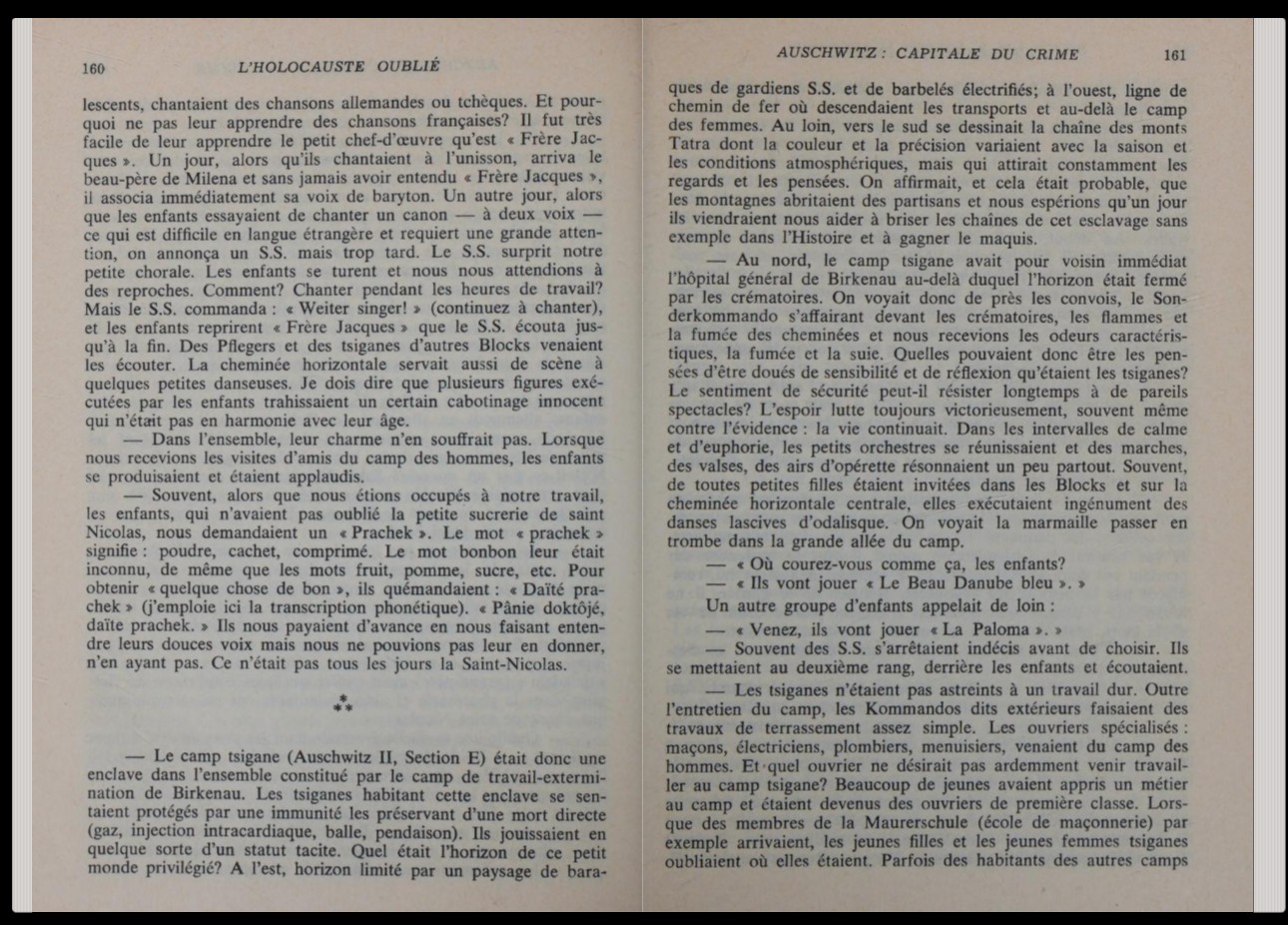
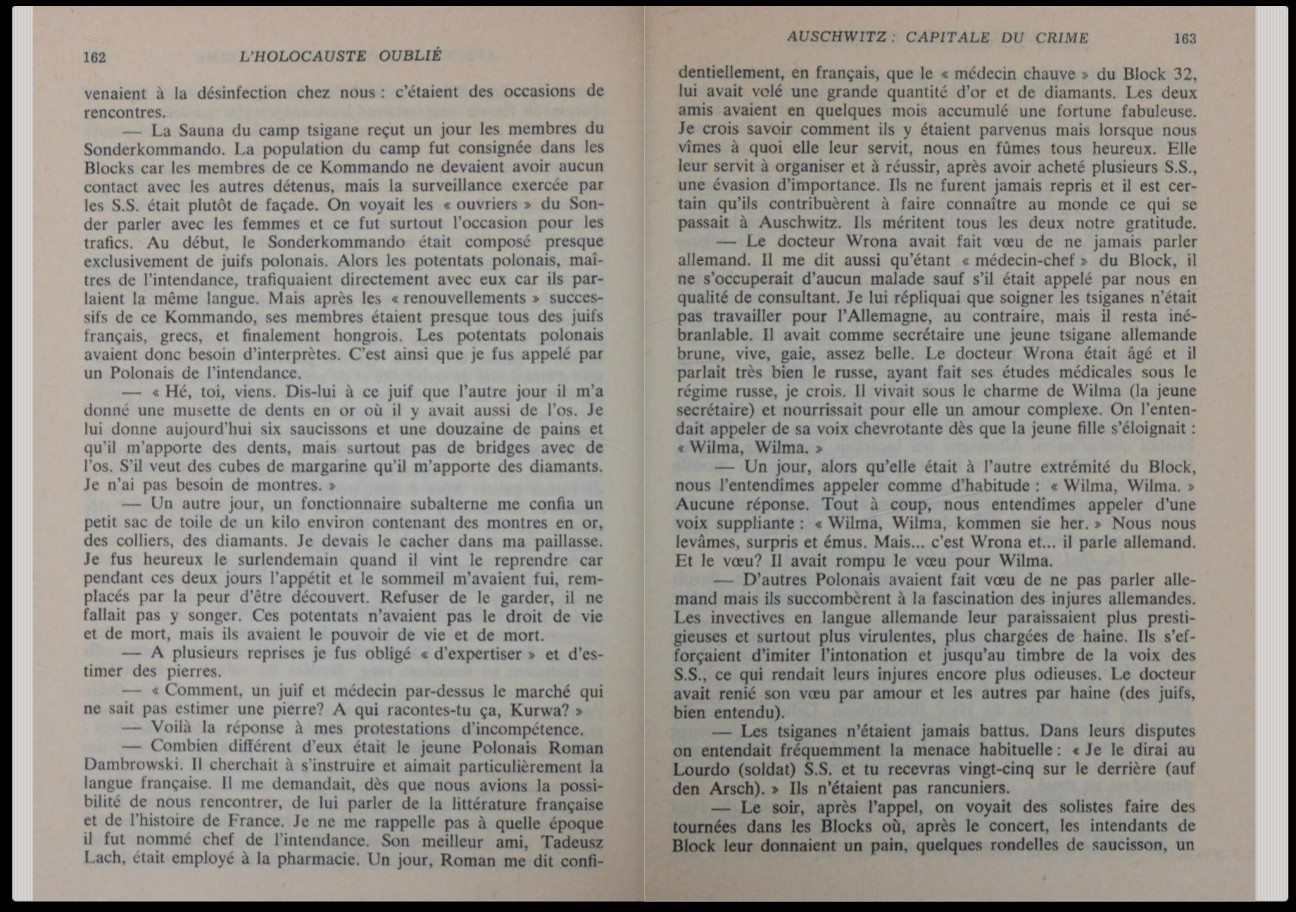
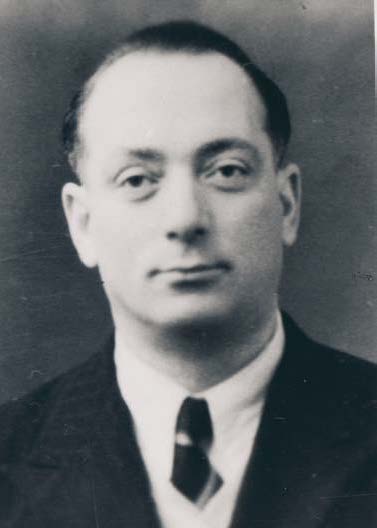
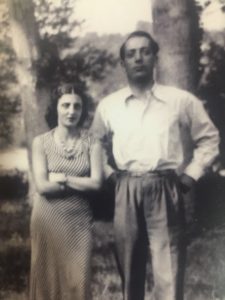
Image 5 (Pages 152 & 153)
Page 152
…finished, Czech Gypsies, sick or orderlies, sang their beautiful and proud Czech songs. They had an innate sense of harmony. As soon as they heard a melody, they harmonized it without any hesitation. One day I was walking silently and alone along the central aisle of the Block. Suddenly, I heard two-part singing performed by women. I approached and listened; then they stopped, a bit embarrassed. I asked them to continue, explaining that it was very beautiful. These young Czech women resumed singing (soprano and alto) with Gypsy words. Odoï telé Balval pour del. Miro pirano, ouj ma moikel, etc. It was a Gypsy prisoner’s complaint full of naive charm. They had an unforgettable voice quality.
— Often the camp seemed asleep: not an SS man. The local bosses—Polish or German tyrants occupied with their affairs: trafficking. Then we went to visit our friends in the Czech or German residential Blocks. Our German Gypsy women friends delighted us especially with the song “Faria.” They had a warm and captivating tone. Recordings of Faria or Odoï telé may exist.
— For non-Gypsy inmates, Germany’s defeat was indisputable, but morale was directly influenced by variations in convoys. Sometimes days and weeks passed without seeing new convoys arrive. Then euphoria took over the camp, and doctors believed more in the usefulness of their work. One day, shirts were distributed to the sick: a good sign.
— Generally speaking, Gypsy orderlies were fairly well dressed. One of the most important garments for them was the shawl. Thanks to their connections, they all had beautiful shawls.
— We know the instinctive and ancestral gesture triggered by feminine modesty surprised by an indiscreet gaze. Works of art reproducing the female body show the gesture accomplished or unaccomplished, seeking to protect the two modest centers most exposed and most vulnerable to the gaze: one hand brought to the throat and the other to the Mount of Venus, and the depression accompanying it. Gypsy women, surprised in their nudity, held themselves in charming confusion, both hands to their heads to hide what robbed them of their femininity: the absence of hair. Then, recovering from their embarrassment, they held one hand lower and hid what they could… with one hand.
Page 153
…In contrast, they used the shawl with admirable art. They made it into a draped headpiece, letting a rectangle fall over each shoulder, framing the head and giving them the grace of painted Egyptian princesses on the walls of tombs and sarcophagus lids. Perhaps it was an ancestral art, but they did not know it. When we told them, they beamed with joy—a small compensation for the profanation of their hair.
— The Sauna was very well set up, and the opportunity for medical personnel to take showers was practically unlimited, but promiscuity was often unavoidable. The SS also crossed freely and frequently through the shower room while people bathed.
— Seniority among Gypsy women in the camp could be recognized by the length of their hair (rarely visible). German female orderlies (Pflegerinnen) kept their hair. Visiting friends in the residential Blocks, we would hear a woman say to us:
— “Turn around.”
— It was not to adjust her bra, but to fix her head shawl so that her cut hair could not be seen. But hair regrew, and alongside hair growth, the SS starvation regimen dishonored their throat, and the modest gesture then became a humiliating movement.
— In this small universe that was the Gypsy camp, the life of the “races” became increasingly intimate. The SS exerted no violence and also experienced the charm of female presence and children’s presence. Between chores and after work, Gypsy musicians formed small orchestras, and the crowd of children was the first to run to form a circle around the performers.
— The SS also approached, and for the most part, the “Achtung” was forgotten. Blows and insults came only from a few Polish and German tyrants (deportees). The latter made it a point of honor not to lose the habit. Friendship bonds formed, and many Gypsy women had relationships with deportees from other camps, and even with the SS. The concept of “Rassenschande” (racial pollution) was nothing more than a facade for many SS.
— Block No. 32, situated across from Block No. 32 [note: across from an odd-numbered block], thus an odd number (31 or 29), was occupied by the Kindergarten (nursery). It was managed by a young German woman. I don’t know her…
Image 6 (Pages 154 & 155)
Page 154
…”civilian” past of German women and young girls who served as Pflegerin in the Gypsy camp, but I can affirm that their conduct was wonderful. Men said they were former prostitutes, but even if true, what a beneficent influence they exercised through their work as orderlies and contact with children!
— In the infirmary blocks, patients being less numerous were more comfortable in their beds, and from time to time there was a distribution of linen. One day Dr. Mengele handed me a box containing 25 or 30 ampoules of “Calcium Gluconicum” (calcium gluconate) to make intravenous injections into my patients to “fortify” them. Three quarters were immediately stolen by a Polish tyrant. “Calcium gluconicum” exercised an extraordinary fascination over the Pflegers (non-doctors, of course). As soon as they reached a “position,” notably a job in administration, they had intravenous calcium injections given to their “friends”—who certainly needed none, having plenty of proteins, carbohydrates, and fats at their disposal. Calcium was, in a way, a medical amulet—and above all gave a Pfleger great prestige in the eyes of his “lady”—a “lady” whose calcium-injecting knight felt humbled before others.
— It is undeniable that Dr. Mengele made efforts to make the life of the Gypsies more bearable. He had some medicines, clothes, etc., taken from the luggage of gassed Jews. But he was not the master, as everything had to be sent to Germany. But science was not to be neglected either, and the Lagerarzt didn’t forget it.
— One day, comrades from neighboring Blocks called us to show us exceptionally rare specimens: cases of heterochromia. An entire family (named Mechau) of seven or eight people—brothers, sisters, cousins, and an uncle—had one black eye and one blue eye. Occasionally one sees “mismatched” eyes, but exceptionally so different. These German Gypsies, tall, vigorous, and apparently healthy, had just arrived. They were divided among the infirmary blocks.
— “Why in the hospital and not in the living blocks?”
— “They aren’t sick. It’s for ‘observation’ (zur Bevlacktung).”
Page 155
— We examine them and my friend J.B. says to me, showing a vigorous young blonde girl:
— “How curious! Anyone who married her would think he had two wives looking at her right profile or left profile.”
— We answer him:
— “You have bigamous thoughts.”
— The next day, Dr. Mengele’s visit follows the usual ceremonial. I have known Mengele for quite a while, so my “Achtung” lacks complete rigidity. On this point, I recall a Lagerarzt (Klein? Lukas?) who signaled to us that he didn’t want “Achtung.” So Mengele calls me aside:
— “Did you see the Mechau family? The heterochromia?”
— I answer him: “Yes, Mr. Lagerarzt.”
— Then he tells me confidentially:
— “Well, when the time comes (wenn es soweit ist), when this and that happen, you understand? You will carefully extract the eyes, put them in bottles that will be prepared for you, and send them to Berlin for examination of iris pigments. You understand, a question of genetics, dominant/recessive heredity, etc., very interesting (Höchstinteressant).”
— Mengele spoke to me with such simplicity, such tranquility, that despite all I had already seen, despite all I knew, I was horrified. And I was horrified not by the fact itself, but by Mengele’s confident tranquility. How, for these handsome young men, these beautiful young girls, neither the gas chamber nor intracardiac injection, but expected and watched death, thus calculated and planned! I think of Doctor Thilo’s reprimand when he held our colleague L.A. responsible for the cachexia of Gypsy women. Doctor Mengele knew that this was bound to happen and held us not responsible. All SS doctors knew the evolution of the moral and physical state of the Gypsies; only Mengele admitted it while Thilo was an ignoble hypocrite.
— And Mengele was not mistaken: scabies came, lesions infected, malnutrition and avitaminosis joined in, tuberculosis settled in or evolved, and in two or three months of “Beobachtung” at the hospital, “the time came” (es ist schon soweit), in other words, that was it. Shortly after…
Image 7 (Pages 156 & 157)
Page 156
…the other, someone brings me a number and a bottle with preservative fluid and… I extract the eyes. Autopsy mostly shows: active tuberculosis. And so weeks pass and no one speaks of the Mechau family anymore.
— One day, the secretary general of the Krankenbau calls me by name. He was a cultured man, speaking French and German fairly well, which is always reassuring when dealing with a Pole. He tells me discreetly:
— “You know, the Mechau family consisted of eight members and you only gave me… fourteen eyes. The last one died two days ago. Have you extracted his eyes?”
— I was stunned. I stammered:
— “Did he die the day before yesterday?”
— “Yes,” he told me very softly. “So is he sent to the crematorium with his eyes? Do you realize, if the Germans found out? Sabotage of science. I’m waiting with the death declaration to the central secretariat, but arrange to extract ‘his eyes’.”
— I take the number and the bottle with preservative fluid, and I only lack the eyes to be in compliance. These eyes of the corpse incinerated the day before yesterday… I felt a strange sense of gratitude toward this Polish secretary. His first name was Wojciech, but his last name, forgotten. Thus, I put my friend M.S. in the loop and he tells me to do the necessary quietly because the secretary is certainly a friend.
— I head as usual to the Leichenkammer (morgue) equipped with my forceps, scalpel, curved scissors, and preservative bottle, and like a thief, I extract a dark eye on a male corpse and a blue eye on another. I check that no one is coming and with a beating heart I begin to read. The lines dance a bit, overlap then settle down, calm down. I wait for evening, the passing of the truck carrying away the corpses. For two days I tremble a bit more. No one calls me. Boris Komarnicki, the Ukrainian inmate-chief of the “Politische,” the terror of deportees, passes peacefully swinging his cane and says nothing. Have I introduced errors into the research of Hitlerite geneticists and anthropologists?
— Did I slow down or fake the march of science? What is certain is that this trickery was a form of legitimate defense.
Page 157
— Wojciech surely didn’t tell anyone¹.
Footnote:
After his liberation from Auschwitz, Hermann Langbein met Professor Von Verschuer, who before the war had been Mengele’s “boss”. — “He told me that Mengele had sent to the Kaiser-Wilhelm Institute eye preparations of exceptional interest. When I told him that these were eyes of Gypsies that Mengele had killed because of this anomaly, he appeared surprised and dismayed. He seemed never to have asked himself the question of their origin.”
— One reads in the Bible (Leviticus 19:28): “You shall not make any cuttings in your flesh for the dead, nor tattoo any marks upon you.” Whatever the opinion of some on this verse, one is allowed to attach more value to the word of the Bible and admit that tattooing is an abomination in the etymological sense of the word. — When it comes to forced tattooing, when someone defiles a child’s body or a woman’s arm, a crime and inexpiable sacrilege are committed. — At the origin of Auschwitz-Birkenau camp, only Jewish inmates of both sexes were tattooed. In the minds of the SS and most “Aryan” inmates, tattooing sealed the difference in fate between the two categories of prisoners: tattooed ones doomed to extermination and non-tattooed ones—not carrying the indelible stigma of the camp—reasonably able to hope for survival, or even liberation. — Gypsies formed a category apart. They were all tattooed on the left forearm. Children’s arms not offering enough space, they were tattooed on the leg or thigh. — In June-July 1943, the order arrived at Auschwitz to tattoo all Aryans (Poles, Russians, Czechs, etc.) except Germans. In the Gypsy camp, this fact, harmless in itself, created great turmoil in people’s minds; it was evident to everyone that the SS were descending a step on the ladder of enslavement of Aryan inmates. But soon this unexpected horror seemed forgotten and for new tattooed inmates nothing had apparently changed. Such was not the case in the main camp of Auschwitz where the event had been interpreted according to its true meaning. Conversations we had with inmates from that camp coming to do work at our place made it easy to deduce that resistance was gaining ground: Kapos, Vorarbeiter, and local bosses in general struck less and…
Image 8 (Pages 158 & 159)
Page 158
…there were fewer injured and fewer deaths from injuries. Their expression, certainly exaggerated, was: “Auschwitz is a sanatorium.” Resistance was secret, limited, but benefits were felt. It is certain that many Aryans realized that the “difference in fate” between them and the Jews was not so sharp.
— Toward the end of autumn 1943, half of our Block became a Gypsy children’s hospital. It was a major event for all medical personnel. Orderlies applied themselves with maternal tenderness to prepare the beds, checking if the wood wool (Hobzwolle) in the straw mattresses had no large splinters that could pierce the casing and injure children. Clean sheets and good blankets were received. Comrades who had to leave often returned to see if children were already there. I will always remember the discreet and happy smile of Dr. Schekter when he showed me the first young patients. They arrived and brought us the freshness and charm of childhood, the light in their eyes, the warmth of their friendship, the music of their babble, the scent of their innocence. In two or three days, fifteen or twenty places were already occupied in the beds. There were only minor cases: seasonal illnesses, illnesses linked to undernourishment, and scabies complications. One day, two Jewish painters arrived from the men’s camp with ladders, brushes, and paints. There was a large partition separating the vestibule from the Block proper, resembling a church tympanum. This partition was painted white, and on this coat, the two artists painted a world forgotten or unknown to the children. In the excitement reigning in the Block, children realized something was happening, and all who could walk went to see. Under the painters’ brushes, a plain was born, hills, a church, houses, trees, a pond, ducks, geese, hens, a cat, a dog, birds, a cow, a goat, a farmwoman. The older children uttered cries of joy and named the animals as they came to life, animals that were familiar to them. The little ones had never seen them or had lost all memory of them, but their joy was just as great and they tried to name them too. The Block leader shouted from time to time in German and Czech: “To bed, children!” but his voice was so mild that the children pretended to obey but stayed. The presence of children brought visible changes in the staff’s attitude. Only two or three young…
Page 159
…bosses wanted to remain inaccessible to feelings of “weakness” and take pride in it, but charm worked.
— One day, our orderlies were particularly busy washing the little ones and making their beds. One would have said an unusual visit was expected. After roll call, which was always held inside, the door opened wide and a magnificent bishop appeared, wearing a golden mitre adorned with precious stones, carrying a venerable white beard, and dressed in a long cape sparkling with gold and silver embroidery. It made a solemn entrance. In his left hand he held a silver crosier enhanced with gems, and choir children followed him. A great silence fell, and after a moment of quiet delight, a song of joy burst out in the beds and filled the whole Block. I asked very softly, in an emotional voice, the meaning of this ceremony, and a comrade answered me that it was Saint Nicholas. The children had recognized the saint and sang the hymn to Saint Nicholas. Unfortunately, I retained neither the lyrics nor the tune. They sang in two languages: German children in German, Czechs in Czech language. The bishop advanced majestically down the aisles along the rows of beds, and his right hand blessed in all directions. Was it not a miracle? Saint Nicholas had descended from the sky into this desolate plain of Hitlerites to bring joy to the Gypsy children of Birkenau camp. And each child received a compressed sugar tablet. What happiness!
— I did not immediately recognize in Saint Nicholas our old comrade, the pharmacist Wladislaw—an exemplary comrade, full of kindness and serenity. Our revered friend spoke perfect French, having studied in Belgium. His luminous intelligence illuminated the atmosphere of the Block and brought courage and comfort. His observations were often severe but always fair, instructive, and enriching, deserving gratitude. Good “dziadzin” (grandfather) had found a few vitamin tablets in the pharmacy, and so the children were able to receive something from Saint Nicholas.
— What joy and gratitude in the eyes of our “angel musicians”! With the help of paper, cotton, cellulose, a broom handle, and rags, orderlies and comrades had managed to make splendid ornaments in secret, and offer the children this unforgettable celebration. The children’s joy was a magnificent reward for them. May Wladislaw Thorazy “dziadzin”, pharmacist, also find there the consolation he deserves.
— Gypsy children loved music and barely convalescing…
Image 1 (Pages 160 & 161)
Page 160
…lescents sang German or Czech songs. And why not teach them French songs? It was very easy to teach them that little masterpiece, “Frère Jacques.” One day, while they were singing in unison, Milena’s father-in-law arrived and, without ever having heard “Frère Jacques,” immediately joined in with his baritone voice. Another day, as the children were trying to sing a round—in two parts—which is difficult in a foreign language and requires great attention, someone warned me of an SS officer, but too late. The SS officer caught our little choir. The children fell silent and we expected a reprimand. What? Singing during work hours? But the SS officer ordered: “Weiter singen!” (Keep singing!), and the children resumed “Frère Jacques,” which the SS officer listened to until the end. Orderlies (Pflegers) and Gypsies from other Blocks came to listen to them. The horizontal chimney also served as a stage for a few little dancers. I must say that several figures performed by the children betrayed a certain innocent showmanship that was not in harmony with their age.
— On the whole, their charm did not suffer from it. When we received visits from friends from the men’s camp, the children performed and were applauded.
— Often, while we were busy at work, the children, who had not forgotten Saint Nicholas’s little sweet, would ask us for a “prachek.” The word “prachek” means: powder, tablet, pill. The word “candy” was unknown to them, as were the words fruit, apple, sugar, etc. To get “something good,” they begged: “Daïté prachek” (I am using phonetic transcription here). “Pânie doktôjé, daïte prachek.” They paid us in advance by letting us hear their sweet voices, but we could not give them any, having none. Saint Nicholas’s Day was not every day.
— The Gypsy camp (Auschwitz II, Section E) was thus an enclave within the overall set-up of the Birkenau labor-extermination camp. The Gypsies living in this enclave felt protected by an immunity preserving them from direct death (gas, intracardiac injection, bullet, hanging). They enjoyed a sort of tacit status. What was the horizon of this privileged little world? To the east, an horizon limited by a landscape of bar-…
Page 161 — Auschwitz: Capital of Crime
…racks of SS guards and electrified barbed wire; to the west, the railway line where transports unloaded and, beyond that, the women’s camp. In the distance, to the south, loomed the Tatra Mountain range, whose color and clarity varied with the seasons and weather conditions, but which constantly drew eyes and thoughts. It was asserted, and it was probable, that the mountains sheltered partisans, and we hoped that one day they would come to help us break the chains of this slavery unprecedented in history and join the resistance.
— To the north, the Gypsy camp had as its immediate neighbor the general hospital of Birkenau, beyond which the horizon was closed off by the crematoria. Thus, one could see up close the convoys, the Sonderkommando bustling in front of the crematoria, the flames and smoke from the chimneys, and we caught the characteristic odors, smoke, and soot. What then could be the thoughts of beings endowed with sensitivity and reflection like the Gypsies were? Can the feeling of security long withstand such sights? Hope always fights victoriously, often even against evidence: life went on. In the intervals of calm and euphoria, small orchestras gathered and marches, waltzes, and operetta tunes resounded almost everywhere. Often, very young girls were invited into the Blocks and, on the central horizontal chimney, ingenuously performed lascivious odalisque dances. One could see the swarm of children racing down the main avenue of the camp.
— “Where are you running off to like that, children?
— “They’re going to play ‘The Blue Danube’.”
Another group of children called out from afar:
— “Come, they’re going to play ‘La Paloma’.”
— Often SS officers stood undecided before choosing. They would stand in the second row, behind the children, and listen.
— Gypsies were not subjected to hard labor. Besides camp maintenance, the so-called external Kommandos did fairly simple earthworks. Skilled workers—masons, electricians, plumbers, carpenters—came from the men’s camp. And what worker did not ardently wish to come and work in the Gypsy camp? Many young people had learned a trade in the camp and had become first-class workers. When members of the Maurerschule (masonry school), for instance, arrived, young Gypsy girls and women forgot where they were. Sometimes inmates from other camps…
Image 2 (Pages 162 & 163)
Page 162
…came for disinfection at our place: these were opportunities to meet.
— One day, the Sauna of the Gypsy camp received members of the Sonderkommando. The camp population was confined to their Blocks because members of this Kommando were supposed to have no contact with other inmates, but the surveillance exercised by the SS was mostly for show. One could see the “workers” of the Sonderkommando talking with the women, and it was above all an opportunity for trafficking. At first, the Sonderkommando was composed almost exclusively of Polish Jews. So the Polish bosses, masters of administration, trafficked directly with them because they spoke the same language. But after successive “replacements” of this Kommando, its members were almost all French, Greek, and finally Hungarian Jews. The Polish bosses therefore needed interpreters. That is how I was called by a Polish man from administration.
— “Hey, you, come here. Tell this Jew that the other day he gave me a bag of gold teeth that had bone in it too. Today I’m giving him six sausages and a dozen loaves of bread, and he better bring me teeth, but especially no bridges with bone. If he wants margarine cubes, let him bring me diamonds. I don’t need watches.”
— Another day, a subordinate official entrusted me with a small cloth bag of about one kilogram containing gold watches, necklaces, and diamonds. I had to hide it in my straw mattress. I was happy two days later when he came back to retrieve it, because during those two days appetite and sleep had fled me, replaced by the fear of being discovered. Refusing to keep it was out of the question. These bosses did not have the right of life and death, but they had the power of life and death.
— On several occasions, I was forced to “appraise” and estimate gemstones.
— “What, a Jew and a doctor to boot who doesn’t know how to appraise a stone? Who are you telling that to, Kurwa?”
— Such was the response to my protests of incompetence.
— How different from them was the young Pole Roman Dambrowski. He sought to educate himself and particularly liked the French language. Whenever we had the opportunity to meet, he asked me to talk to him about French literature and French history. I don’t remember at what time he was appointed head of administration. His best friend, Tadeusz Lach, was employed at the pharmacy. One day, Roman told me confi-…
Page 163
…dentially, in French, that the “bald doctor” from Block 32 had stolen a large quantity of gold and diamonds from him. The two friends had accumulated a fabulous fortune in a few months. I believe I know how they achieved it, but when we saw what purpose it served them, we were all happy. It served them to organize and succeed in a major escape, after bribing several SS officers. They were never recaptured, and it is certain that they contributed to making known to the world what was happening at Auschwitz. They both deserve our gratitude.
— Doctor Wrona had taken a vow never to speak German. He also told me that, as “chief doctor” of the Block, he would not attend to any patient unless called upon by us as a consultant. I replied to him that treating Gypsies was not working for Germany—on the contrary—but he remained steadfast. As his secretary, he had a young German Gypsy girl: dark-haired, lively, cheerful, quite pretty. Doctor Wrona was elderly, and he spoke Russian very well, having completed his medical studies under the Russian regime, I believe. He lived under Wilma’s spell (the young secretary) and harbored a complex love for her. One could hear him calling in a quavering voice as soon as the young girl walked away: “Wilma, Wilma.”
— One day, while she was at the other end of the Block, we heard him calling as usual: “Wilma, Wilma.” No answer. Suddenly, we heard him call in a pleading voice: “Wilma, Wilma, kommen Sie her.” [Wilma, Wilma, come here.] We stood up, surprised and moved. But… it’s Wrona and… he’s speaking German. What about the vow? He had broken his vow for Wilma.
— Other Poles had taken a vow not to speak German, but they succumbed to the fascination of German insults. Invectives in the German language seemed to them more prestigious and, above all, more virulent, more charged with hatred. They strove to imitate the intonation and even the vocal timbre of the SS, which made their insults even more hideous. The doctor had renounced his vow out of love, and the others out of hatred (of Jews, of course).
— Gypsies were never beaten. In their arguments, one frequently heard the usual threat: “I’ll tell the SS Lourdo (soldier) and you’ll get twenty-five on the rear (auf den Arsch).” They were not resentful.
— In the evening, after roll call, soloists could be seen touring the Blocks where, after the concert, the Block administrators gave them a loaf of bread, a few slices of sausage, a…
Image 3 (Pages 164 & 165)
Page 164
…piece of margarine, etc. On several occasions we listened to a zither player, a true virtuoso. I will never forget an old father with his son, Russian Gypsies. The father played the viola wonderfully, and the son, a virtuoso violinist, had attended the conservatory in Kiev. I never saw brass instruments in the camp’s Gypsy orchestras. The head of Block 24 organized dances every evening. This Blockältester, a Reichsdeutscher (German from the Reich), had a very unflattering appearance, but his physical shortcomings were offset by the food and luxurious women’s clothing at his disposal. Thus, he had a young Gypsy girl of great beauty as his companion.
— At that time, we had a German Lagerältester-Krankenbau (head of the Revier, an inmate), red triangle, polite and somewhat educated. He had a liking for speeches and often gathered us to deliver addresses to us. In every single one of his addresses appeared the following sentence, heavily emphasized:
— “Ich gehe keine Verbindungen ein” [I do not enter into any relationships, “female implied”].
— By this, understand: I am made of steel, of bronze, incorruptible, insensitive to female charm. Let us remember that in 1943, there was someone in Germany who embodied complete asceticism. It was “the Führer.” Our Lagerältester thus had a model of chastity, abstinence… And this model also never missed an opportunity to talk about it with ostentatious discretion. We were to learn, after the collapse of the Third Reich, what that asceticism was really about.
— The head of the Revier tirelessly repeated:
— “Whoever does not scrupulously do his duty (which one?), I will take him by the sleeve and lead him straight to mister (sic) the Blockführer.”
— We were surprised to see a political prisoner venerate and respect “mister the Blockführer” outside his presence. My friend Doctor Von Engelhard diagnosed a state of Stultitia excelsa [supreme stupidity]. This diagnosis reached, no one knows how—and translated into German—the ears of Herr Blockführer. The latter gathered all male and female personnel in front of the Block, delivered an address, and thrashed Doctor Engelhard. Once the Blockführer had left, the head of the Revier in turn gave a short speech and concluded by asking the beaten man:
— “What, a man who speaks with respect of Herr Blockführer and scrupulously fulfills his duty is an idiot to you?”
Page 165
— He did not suspect that he had just formulated a brilliant definition of the perfect idiot.
— A friend said softly when we were alone:
— “It is written ‘the fear of God is the beginning of wisdom.’ Veneration of the SS is the sum of wisdom.”
— The proximity of the places of extermination did not prevent the blossoming of deep feelings and youthful romances. One did not see hearts carved into the bark of trees in which young lovers inscribe their first names, but one saw in the washrooms or on the hidden partitions of the barracks hearts pierced by an arrow and bearing a first name and often a number preceded by Z (Gypsy), for example: Mietek → Z 8247, etc.
— There were also young and less young Gypsy men who, with a naive vanity, concocted and laboriously maintained a reputation as heroes of romantic adventures, such as this Heinz, a low-level employee somewhere in the kitchen or the Schreibstube [writing office].
— Every day he came to visit a sick young woman in our Block. He called Liselotte his wife, and she called Heinz her husband. Some time later, when she had been discharged from the hospital for several weeks, I met Heinz and asked him in a friendly way:
— “How are you doing?”
— He answered me with the usual joke in the Gypsy camp: “Schlechten Menschen geht’s immer gut.” [Bad people are always doing well.]
— “And Liselotte, how is she doing?”
— “Which Liselotte? I have many Liselottes.”
— I observed and verified from the beginning of my stay until the end of the camp’s existence that Czech and Slovak women were exemplarily faithful. The attraction of food and clothing advantages was rarely decisive in accepting a position as concubine or wife “Gypsy-style.” German Gypsy women, on the other hand, were more easily dazzled by prospects of food and clothing comfort. As for relations between SS officers and German Gypsy women, there was also a contributing factor in the common language and often shared memories from the time when they were free.
— Many SS officers regularly came to visit Gypsy women, and young people, often their own little girls, kept watch so that the mother and the SS officer would not be caught by surprise, which could have had serious consequences for both.
Image 4 (Pages 166 & 167)
Page 166
One must not attribute the consent of these women to venality. It was often a matter of sincere love or ill-endured chastity. Furthermore, in the eyes of German Gypsy women, the SS were soldiers, and the sight of these soldiers was familiar to them in free life (“outside,” as people in the camp said to denote freedom). These soldiers were at the camp because they were assigned there, and in the minds of German Gypsies who had no political awareness, the SS officer was not an enemy.
— In July–August 1943, I had among my patients a young man suffering from typhus whose legs had both been amputated following accidental injuries. This patient, a Tyrolean Gypsy, was frequently visited by an Austrian SS officer, a splendid fellow, his childhood friend. Every time, the SS officer would tell me:
— “Take good care of him, you’ll get two cigarettes.”
— Mothers’ sharp eyes quickly notice when their daughter attracts someone. Such was the case with Lisa’s mother. Lisa was seventeen or eighteen years old and was in the hospital at the same time as her mother, both suffering from typhus and infected scabies. Lisa was blonde and had a statuesque figure. Despite her cut hair, her thinness, and her scabies, no one could look at her without admiring her. Her mother noticed that people were casting admiring glances at her. She called me to her bedside one day and said:
— “You know, Lisa isn’t really a Gypsy; she only has a ‘minus’.”
— Which meant that Hitlerite anthropologists had failed to determine with certainty the proportion of Gypsy blood flowing in her veins. I replied to her as anyone would have replied: that Lisa’s beauty and grace, despite her Gypsy blood, far exceeded the beauty of many German Aryan women, even if she had a higher “percentage.” What can one say? Deficiency edema and enteritis soon set in, and the Block leader had her transferred to the Durchfall [diarrhea] Block where the straw mattresses were rotten and the sick, in any case, sacrificed. I went to see her every day, and she passed away with a smile of hope and in the joy that people still found her beautiful (dennoch schön). In death, she was as beautiful as Denise, the French “Gypsy” who died of tuberculosis.
— In free life, death, even when victorious, wins after a hard struggle. The organism, aided by society, friends, parents, and doctors, fights and exhausts itself, and death, finally victorious, finds an exhausted body that is but a shadow of the vanquished being. On the other hand, in the camp, Society is hostile, friends and family are…
Page 167
…often far away, and doctors virtually helpless. The body does not exhaust itself fighting, and death, when it comes, snatches life away and is often powerless against beauty. Hence the beauty in death of the young Gypsy women and girls who died at Auschwitz.
how I got here….






[…] Previous Next […]
[…] Dr. Jancou Vexler’s FINISHES Lying Perjurer Miklos Nyiszli Part 2 – Vexler’s Exten… Gallery […]
[…] Dr. Jancou Vexler’s FINISHES Lying Perjurer Miklos Nyiszli Part 2 – Vexler’s Exten… […]
[…] Dr. Jancou Vexler’s FINISHES Lying Perjurer Miklos Nyiszli Part 2 – Vexler’s Exten… […]
[…] Dr. Jancou Vexler’s FINISHES Lying Perjurer Miklos Nyiszli Part 2 – Vexler’s Exten… […]
[…] Dr. Jancou Vexler’s FINISHES Lying Perjurer Miklos Nyiszli Part 2 – Vexler’s Exten… […]